

Percepta’s Award-Winning Learning Strategy Wasn’t a Curriculum—It Was a Mindset

This year, Percepta’s facilitation program earned a Brandon Hall Group HCM Excellence Silver Award for Best Learning Strategy. The recognition speaks to more than innovation—it reflects execution at scale. By reskilling trainers as facilitators, we built a scalable, sustainable approach to learning that keeps pace with the speed of business change.
But the real story goes beyond awards. In automotive CX—and in any fast-moving industry—the future depends not just on the technologies we deploy, but on how we train and empower the people behind the experience.
In the article below, Brian Shumaker, Percepta’s Director of Global Learning Delivery and creator of our facilitation training program, shares how this award-winning approach transformed more than training, it helped build a learning culture designed to move with the business.
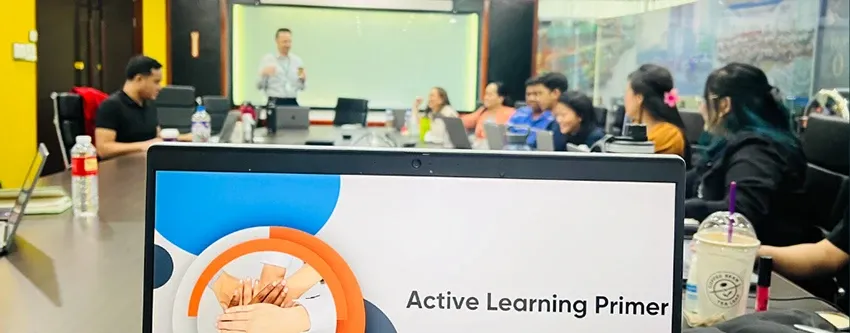
The Real ROI of Active Learning Isn’t Just Faster Agents—It’s a Learning Culture
By Brian Shumaker, Director of Global Learning Delivery
Can you think of a time when you learned something completely new?
How did you learn it, and what made you successful?
I often ask this question at the start of L&D workshops. People’s answers vary and are often surprising – car repairs, baking projects, new arts & crafts, app coding, martial arts – but the pattern is almost always the same. People are already motivated, they independently seek out resources and expertise, and then they do it. They fail, reflect, try again, and improve until they succeed.
What’s almost never mentioned? Reading manuals or sitting through a PowerPoint lecture.
That distinction mirrors what learning science has long confirmed: learning should be active, not passive. It’s that dynamic cycle of reflection, experimentation, and mutual influence that Percepta’s Active Learning program was built to unleash.
From Theory to Practice: Building a Scalable Learning Model that Works
Active learning—an approach that emphasizes learning by doing, reflecting, and collaborating—is now widely recognized as best practice for adult development. Grounded in proven theories like experiential learning, social constructivism, and andragogy, it mirrors how adults retain and apply knowledge in real-world settings.
A landmark meta-analysis by Freeman et al. (2014) examined over 200 studies and found that learners in active learning environments scored ~6% higher on exams and were 1.5 times less likely to fail than their peers in traditional lecture-based settings. More recent research confirms this advantage, showing that learning by doing, reflecting, and applying knowledge in context consistently leads to stronger retention and performance—especially in fast-paced, high-stakes environments like ours (Engageli, 2025; Deslauriers et al., 2019).
When Percepta set out to transform our global training experience, we didn’t just design a new curriculum—we operationalized the science. Our goal was to empower facilitators to lead learning the way adults naturally learn: by engaging directly, thinking critically, and adapting on the fly.
That shift couldn’t have come at a better time. Percepta’s Global Learning & Knowledge team supports more than 100 new-hire programs across a fast-moving, globally distributed contact center environment. As customer expectations and business processes evolved faster than training content could be updated, traditional approaches created bottlenecks. New program launches and major updates were the top priority for design & development resources, meaning that process updates to existing courses often had to be put on the back burner. Facilitators were often left to fill gaps in real time, while learners entered roles feeling underprepared—and engagement and confidence suffered as a result.
We needed a model that could scale with the business without sacrificing learning quality. And that meant turning proven learning theory into everyday practice.
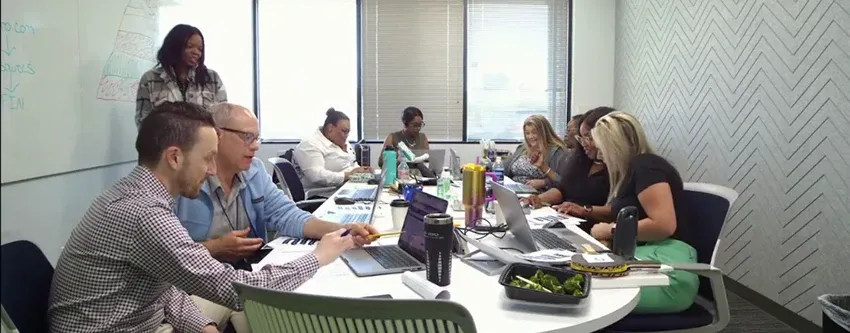
The Solution: Certify the Trainer, Not Just the Training
Instead of relying on curriculum overhauls, Percepta made a strategic pivot: reskill the trainers themselves.
The program trained more than 50 global facilitators to embed active learning techniques directly into sessions with minimal content changes. Trainers were empowered to favor methods like scenario-based practice, role play, guided discussion, debrief, and reflection—turning passive sessions into dynamic, learner-driven experiences, all without waiting for a full curriculum redesign.
But improving the “how” of facilitation wasn’t enough. We also needed to reframe the “why.”
That’s where Creative Interchange comes in. It’s not just a facilitation method—it’s the mindset shift that made the transformation stick. Rooted in Henry Nelson Wieman’s theories, Creative Interchange encourages trainers to think differently about their role in the learning process. At its core, it’s a dynamic, collaborative approach that helps facilitators:
- Build awareness of themselves, their learners, and the learning environment
- Lead with authenticity and appreciation
- Reflect intentionally on what’s working and what’s not
- Co-create meaningful learning experiences alongside their participants
This way of thinking helped transform active learning from a set of techniques into a cultural shift—one where trainers grow alongside their learners, and learning becomes a shared experience rather than a one-way transfer of information.
This focus on mindset challenged facilitators to move from being a source of information to becoming an enabler of learning—guiding discovery rather than delivering answers.
One senior trainer described the shift this way:
My delivery before was very heavily based on me giving out information and feeling like I need to make sure that everybody knows every bit of info. Whereas with the active learning approach, I really had to think about, OK, call them to discover the information for themselves, and then have a conversation about it after. Because I think that is the main difference between the two. It’s really allowing the learners to discover the information themselves rather than lecturing them about it.
This mindset-led approach not only delivered immediate improvements in learning outcomes, it sparked a broader cultural shift. Training became more adaptive, scalable, and aligned with how people actually learn—while also freeing instructional design resources to focus on the most critical launches and updates.
The Impact: Early Results at Scale
Within the first year:
• Over 50 facilitators certified across six continents.
• Average Handle Time decreased by 44 seconds (a 10% improvement) for agents trained by active learning facilitators, while other performance metrics held steady.
• Overall learner satisfaction rose (4.64 → 4.9).
• Learner satisfaction with their trainer increased (81% → 88%).
• Facilitators described feeling more engaged, with stronger belief in their own growth opportunities and greater appreciation for Percepta’s support of their development.
These results show that active learning, fueled by Creative Interchange, is more than a training program—it’s a catalyst for organizational change.
In automotive CX, the pace of change is relentless: new vehicle technologies, connected services, and evolving ownership models mean front-line teams are constantly adapting. Active learning gives them the agility to keep pace with shifting technology, regulations, and customer expectations, turning training into a competitive advantage for OEMs and service providers alike.
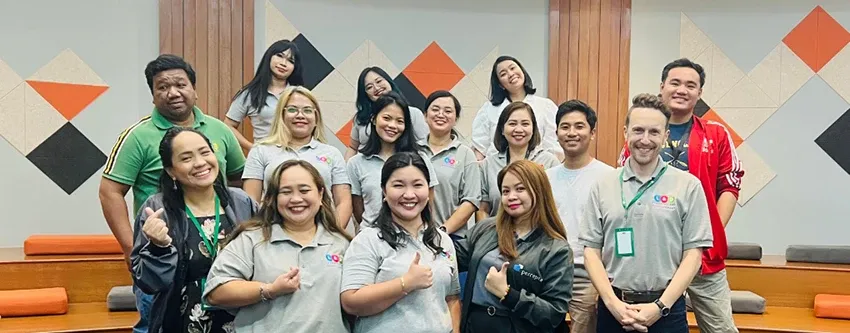
An active learning certification ceremony in Manilla, 2024
Why It Matters
In a world moving fast toward automation and AI-driven everything, it’s easy to lose sight of how real learning happens. At Percepta, we believe the future of capability building isn’t just automated—it’s experience-led, facilitator-driven, and built for adaptability.
This program doesn’t replace technology; it complements it. By equipping facilitators to lead with intention, activate learning through experience, and adapt to the moment, we’re building something AI alone can’t deliver: a resilient learning culture where people grow in sync with change, not behind it.
And at the heart of that culture is a simple truth: the biggest obstacle to learning is often what we think we already know. For expert trainers, real impact comes not from imparting every answer, but from letting go, creating space for learners to struggle, discover, discuss, reflect, and succeed with guidance. In that letting go, transformation becomes mutual, and both learners and facilitators grow together.
Because in the end, real transformation doesn’t come from technology – it comes from people becoming more than they were yesterday.