
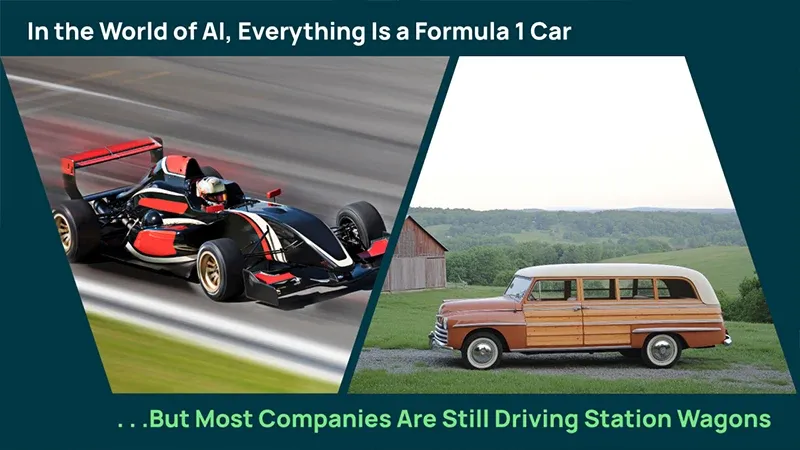
In the World of AI Everything Is a Formula 1 Car, But Most Companies Are Still Driving Station Wagons
Our Director of Data Analytics, Hershel Eason and AI Product Architect Sarah Hunter recently attended the Databricks AI Summit (DAIS) held in San Francisco in June, where the conversation wasn’t just about what’s possible with AI—it was about what’s actually feasible.
In this issue, Hershel reflects on the disconnect between flash and function in today’s CX landscape—and what it really takes to future-proof your tech stack.

When High-Tech Gets Too Far Ahead of Readiness
By Hershel Eason, Director of Data Analytics at Percepta
Walking the floor at the Databricks AI Summit this summer was like stepping into a Formula 1 garage. Everywhere you turned, there were high-performance tools promising zero-to-one transformation—autonomous QA, automated data redaction, turbocharged model pipelines, all gleaming with potential. But looking around, I couldn’t help thinking:
This is a pit lane full of formula 1 race cars, and most companies are still showing up in a wood-paneled station wagon.
The tech is impressive. But most organizations don’t have the garage, the team, or the track to use it. At DAIS, Sarah Hunter (a brilliant AI Product Architect on our team) and I kept seeing the same thing: AI is evolving at a breakneck pace—but organizational readiness isn’t. And that mismatch matters.
Across industries—from energy to automotive to tech—everyone’s watching the AI race. Few are actually driving in it.
One company was still standing up a data science function. Another admitted they were circulating performance reports in CSVs. And when vendors pitched synthetic data tools, companies responded: “We’re still figuring out where to store our real data.”
These are smart, well-funded business and Fortune 500 companies. But the theme was consistent: the gap isn’t about vision—it’s about infrastructure.
Infrastructure, Not Imagination, Is the Bottleneck
Even advanced shops are struggling to build a foundation that can keep up. At DAIS, we saw a wave of vendors not selling standalone tools, but offering infrastructure-as-a-service—platforms designed to help companies adapt faster as the ground shifts beneath them. And that shift is real.
Some models are advancing so quickly, they’re breaking the very benchmarks designed to measure them. Just this year, Google’s Gemini overtook OpenAI’s GPT‑4 on multiple evaluation tests—only to be outpaced weeks later by Claude, Anthropic’s newest model. Each time companies get ready to evaluate one model, a better one is already out. From a CX perspective, that makes AI a moving target—and if your foundation isn’t flexible, you’re always playing catch-up.
You don’t just swap your station wagon for a Formula 1 car and expect to win a race. You need telemetry. You need a pit crew. You need a system built for speed. Today’s AI tools may look like Ferraris—but most CX orgs are still learning how to shift gears and are stuck in first.
From Agent-less Ambitions to Hybrid Reality
And it makes sense. We’re now seeing in real life what research predicted two years ago. In a 2023 study published by the National Bureau of Economic Research, researchers from Stanford and MIT examined a Fortune 500 contact center using a generative AI assistant. The AI didn’t replace agents—it listened and suggested better responses modeled on top performers.
The result? A 13.8% productivity boost, with lower-performers rising to meet mid-tier peers. Even more telling: when the AI was turned off, performance stayed high. The floor had risen. That’s what real enablement looks like.
Early adopters who leaned into “agent-less” automation are now rethinking. According to Gartner, 50% of companies that tried to reduce agent involvement with AI will reverse course by 2027 citing poor escalation paths, empathy gaps, and rising dissatisfaction. The new model? Hybrid service, where AI handles routine tasks and humans manage the relationship.
We’re already seeing this shift. Klarna made headlines in 2025 for replacing much of its frontline staff with AI. Productivity soared but so did scrutiny. CEO Sebastian Siemiatkowski later admitted:
“Ironically, our ROI might have been higher had we kept more humans.” — Fortune, May 2025
Built for the Turns Ahead
At Percepta we designed DAISY (Data Analytics Insights System) to support, not supplant. Its First-Pass QA doesn’t take analysts out of the loop, it sharpens their focus, helping them prioritize where human judgment is needed most.
And it’s built to last. DAISY doesn’t rely on chasing the next big model. Instead, we fine-tune existing ones, because in today’s AI landscape, agility is everything. If we’d trained DAISY a year ago and left it untouched, it’d already be outdated. But because the cost and complexity of fine-tuning have dropped so dramatically, we can continuously re-voice and refresh as better models emerge. New benchmark? New use case? No problem. We’re built for that.
DAISY doesn’t just adapt to the future, it’s designed to keep pace with it.
So no, most CX teams don’t need to race to the front. They need systems that can go the distance.
Because in this next era of AI, winning won’t come from who’s fastest—it’ll come from who’s still in the race.